
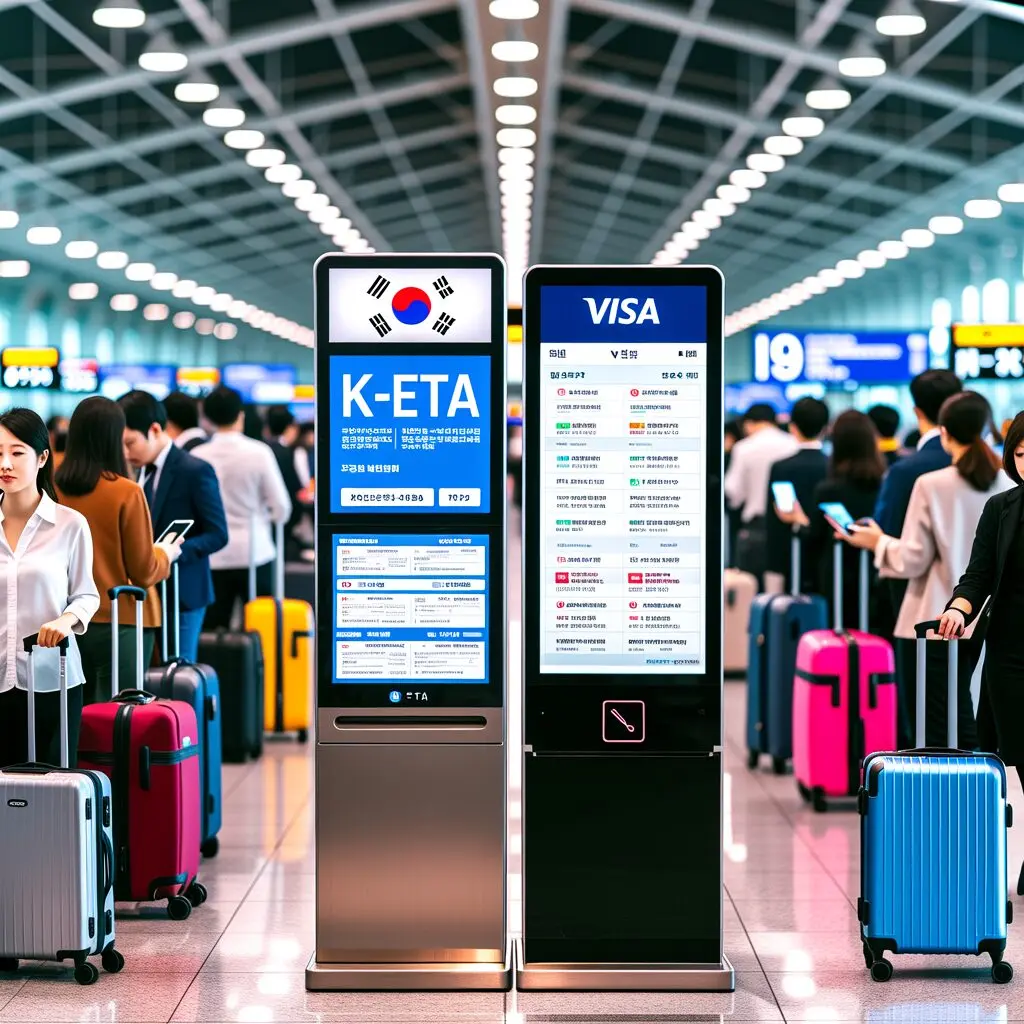
Many travelers heading to South Korea wonder whether they need a K-ETA or a visa. The two serve different purposes, have different requirements, and apply to different situations. Understanding the difference can save you time, money, and potential problems at the airport.
This guide explains the key differences between K-ETA and a Korean visa, when you need each one, and how to determine which applies to your trip.
What Is K-ETA?
K-ETA (Korea Electronic Travel Authorization) is a pre-travel electronic screening for citizens of visa-waiver countries. It is not a visa. It is a digital authorization that allows you to board a flight to South Korea and enter for short-term purposes.
Key characteristics of K-ETA:
- Applied for entirely online
- Costs 10,000 KRW (~$8)
- Processed in 15 minutes to 72 hours
- Valid for 3 years with unlimited entries
- Covers tourism, business meetings, family visits, and transit
- Does not permit work or long-term study
What Is a Korean Visa?
A Korean visa is an official permit issued by a Korean embassy or consulate that allows you to enter South Korea for a specific purpose and duration. There are many types of Korean visas, each designed for different activities.
Common visa types:
| Visa Code | Purpose | Typical Duration |
|---|---|---|
| C-3 | Short-term tourism/business | Up to 90 days |
| C-4 | Short-term employment | Up to 90 days |
| E-1 | Professor | 1–2 years |
| E-2 | English teacher | 1–2 years |
| E-7 | Professional worker | 1–3 years |
| D-2 | Student | Duration of studies |
| D-4 | Language training | 6 months – 2 years |
| F-1 | Visiting family | 1–3 years |
| F-2 | Resident | 1–3 years |
| F-5 | Permanent resident | Unlimited |
| F-6 | Spouse of Korean citizen | 1–3 years |
K-ETA vs. Visa: Side-by-Side Comparison
| Feature | K-ETA | Korean Visa |
|---|---|---|
| What it is | Electronic travel authorization | Official entry permit |
| Who needs it | Visa-waiver country nationals | Non-visa-waiver nationals, or those doing activities K-ETA does not cover |
| Application method | Online only (website or app) | Embassy or consulate in person |
| Cost | ~$8 USD | $50–$200+ depending on type |
| Processing time | 15 min – 72 hours | 5 days – several weeks |
| Validity | 3 years | Varies by visa type |
| Entries | Multiple | Single or multiple (varies) |
| Allowed activities | Tourism, business meetings, family visits, transit | Depends on visa category |
| Work allowed | No | Depends on visa type |
| Study allowed | Short courses only (under 90 days) | Yes, with D-2 or D-4 visa |
| Extendable | No (reapply with new dates) | Yes, in many cases |
| Applied for at | k-eta.go.kr | Korean embassy or consulate |
When You Need K-ETA (Not a Visa)
You need K-ETA if all of the following apply:
- You hold a passport from a visa-waiver country
- Your purpose is tourism, a business meeting, visiting family, or transit
- Your stay is within the visa-free period (usually 90 days)
- You are not working, studying, or residing in South Korea
Note: As of 2026, 67 countries are temporarily exempt from K-ETA through December 31, 2026. If your country is on the exemption list, you do not need K-ETA but may still apply voluntarily.
When You Need a Visa (Not K-ETA)
You need a visa instead of (or in addition to) K-ETA if:
- You plan to work in South Korea (any type of employment)
- You are enrolling in a degree program or long-term language course
- You want to stay longer than the visa-free period allows
- You are from a country that does not have a visa-waiver agreement with South Korea
- You are joining family permanently
- You are doing activities that require a specific visa category (journalism, religious work, etc.)
When You Need Both K-ETA and a Visa
In most cases, you need either K-ETA or a visa, not both. However, there are edge cases:
- If you hold a visa that is about to expire and plan to re-enter visa-free, you may need K-ETA for the visa-free re-entry
- If your visa covers one purpose but you want to do something different (e.g., you have a student visa but want to do a short business trip), consult the Korean embassy
The e-Arrival Card: A Third Option
Since February 2025, South Korea has offered the e-Arrival Card as a digital alternative to paper arrival forms. This is separate from both K-ETA and visas.
- e-Arrival Card — A digital arrival/departure form that all visitors must complete (unless exempt)
- K-ETA — A pre-travel authorization that exempts you from the e-Arrival Card
- Visa — An entry permit for specific purposes
If you have a valid K-ETA, you do not need to fill out the e-Arrival Card. If you are entering under the K-ETA exemption (no K-ETA required), you must complete the e-Arrival Card at www.e-arrivalcard.go.kr before arrival.
K-ETA vs. Similar Systems in Other Countries
K-ETA is South Korea’s version of electronic travel authorization, similar to systems in other countries:
| Country | System | Fee | Validity |
|---|---|---|---|
| South Korea | K-ETA | ~$8 | 3 years |
| United States | ESTA | $21 | 2 years |
| Canada | eTA | CAD $7 | 5 years |
| Australia | ETA | AUD $20 | 1 year |
| United Kingdom | ETA | £10 | 2 years |
| European Union | ETIAS (upcoming) | €7 | 3 years |
All of these systems serve the same purpose: pre-screening travelers from visa-waiver countries before they board their flights.
Common Confusions
“I have a K-ETA, so I can work in South Korea”
False. K-ETA does not authorize employment of any kind. To work in South Korea, you need an appropriate work visa (E-1 through E-7, etc.).
“K-ETA is a type of visa”
False. K-ETA is an electronic travel authorization, not a visa. It is a lighter, faster, cheaper process designed for short-term visitors from friendly nations.
“I don’t need K-ETA because I have a connecting flight”
It depends. If you stay in the transit area and do not pass through Korean immigration, you do not need K-ETA. If you leave the airport or pass through immigration, you need K-ETA or a visa.
“My K-ETA means I’m guaranteed entry”
False. An approved K-ETA allows you to board a flight and approach the immigration counter. The immigration officer at the port of entry makes the final decision on whether to admit you.
“I need a new K-ETA for each trip”
False (usually). K-ETA is valid for 3 years with unlimited entries. You only need a new one if your passport changes, your personal details change, or the 3-year validity expires.
How to Decide: Quick Decision Guide
- Are you from a visa-waiver country?
- Yes → You may be eligible for K-ETA (go to step 2)
- No → You need a visa
- Is your country currently exempt from K-ETA?
- Yes → You don’t need K-ETA (but can apply voluntarily)
- No → You need K-ETA (go to step 3)
- What is your purpose of visit?
- Tourism, business meeting, family visit, transit → K-ETA is sufficient
- Work, study, long-term stay → You need a visa
- How long will you stay?
- Within the visa-free period (usually 90 days) → K-ETA is sufficient
- Longer than the visa-free period → You need a visa
Frequently Asked Questions
Can I switch from K-ETA to a visa while in South Korea?
Generally, no. You cannot change your immigration status from visa-free entry (K-ETA) to a visa status while inside South Korea. You would typically need to leave and re-enter with the appropriate visa.
Do I need K-ETA if I already have a valid Korean visa?
No. If you have a valid Korean visa, you do not need K-ETA. Your visa authorizes entry for its specific purpose.
Can I apply for K-ETA and a visa at the same time?
There is no rule against it, but it is unnecessary. Determine which one you need based on your purpose of stay and apply for that one.
Is K-ETA required for Jeju Island?
Jeju Island has its own visa-free entry policy that allows stays of up to 30 days for most nationalities without K-ETA or a visa. However, this only applies if you fly directly to Jeju and do not transit through mainland South Korea.
What if I’m denied a visa — can I use K-ETA instead?
If you are from a visa-waiver country and your purpose of visit falls within K-ETA’s coverage (tourism, business, family visit), you may apply for K-ETA. However, if you were denied a visa due to immigration concerns, your K-ETA application may also be denied.
Last updated: July 2026. Immigration policies can change. Verify requirements on the official K-ETA website at www.k-eta.go.kr or with your nearest Korean embassy.